










There seems to be no end in sight for the stock market crash. Investors, especially foreign, are exiting Indian equities with record outflows continuing. Sensex is down almost 16% from its lifetime intraday high, and hasn’t hit a fresh closing high in over two years now!Yet a striking divergence is emerging, and one that points to a more complex picture of India’s stock market prospects and fundamentals.Even as Sensex continues to bleed, Dalal Street’s IPOs (Initial Public Offerings) are seeing strong investor interest. So while the secondary market is seeing exodus, the primary market is painting a robust picture.Let’s look at some startling numbers:Foreign portfolio investors (FPIs) invested $1 billion (Rs 9,676 crore) in IPOs in September even as they sold $4.8 billion (Rs 45,537 crore) worth of listed equities, the highest monthly outflow since April 2026, when they withdrew $6.7 billion (Rs 63,167 crore).And, this trend extends beyond one month: in the first nine months of 2026, FPIs poured in $5.9 billion into the primary market while pulling out $33.7 billion from listed stocks.In 2026, FPIs have sold Rs 2,95,971 crore through the exchanges but put Rs 54,398 crore into IPOs.Not just FPIs, even retail investors are displaying a similar shift. After buying Rs 42,774 crore worth of listed shares in the June quarter, they sold Rs 5,674 crore in July and August, while investing more than Rs 12,618 crore in IPOs, sharply up from Rs 1,307 crore in the preceding quarter.Also Read | Two years ago Sensex hit lifetime high: What went wrong after that & what’s the road ahead?Contextually, the move comes amid a surge in new offerings and stronger listing-day returns. The shift, however, does not necessarily signal an exit from equities.Retail investors invested nearly Rs 37,070 crore in listed shares and Rs 13,925 crore in IPOs in the first five months of FY27, taking their combined investment to Rs 50,995 crore.
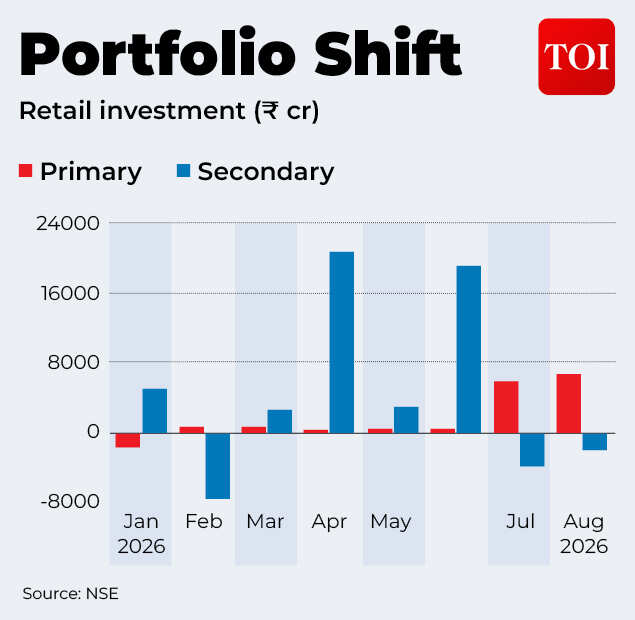
Retail investment entering primary market more
So, amid rising crude oil prices and US bond yields, why are investors exiting stocks but retaining interest in IPOs? What’s happening? Let’s understand:
Why are investors buying IPOs and selling stocks?
Fundamentally, what is happening is asset re-allocation driven by relative valuations.“In the secondary market, benchmark indices and major listed companies have reached elevated valuation multiples following a sustained multi-year rally. This has prompted foreign and domestic institutional investors to systematically take profits and trim exposure in mature, fully valued counters,” explains Sneha Poddar, VP of Research at wealth management, Motilal Oswal Financial Services.For FPIs, IPOs also offer access to growth-oriented businesses, sometimes at discounts to listed peers, without the same price impact associated with large secondary-market transactions.“Capital is simply being re-allocated from high-valuation secondary equities into higher-growth primary issuances to optimize returns,” she tells TOI.In fact, market experts note that there is no real contradiction in the current trends, the moves are all about price-led decision making.According to Ratiraj Tibrewal, CEO of Choice Capital Advisors, listed large-caps are fully valued and easy to sell when global yields rise.“On the other hand, IPOs offer a fixed price, often at a discount to listed peers, and a sizeable allocation. So foreign investors are cutting where valuations look stretched and adding where entry looks better,” Tibrewal tells TOI.Yet another factor that is working in favour of IPOs is currency depreciation effect in existing stocks. The rupee has been falling against the US dollar for several quarters now, and foreign investors are finding it lucrative to exit stocks and put a part of the money into IPOs.“With high US yields and rupee depreciating, FPIs are trimming expensive, liquid large caps and redeploying a part of that money into IPOs, for which there is size, and allocation certainty and pricing discount in some cases,” says Thomas V Abraham, Research Analyst at Mirae Asset Sharekhan.“Even in cases of no listing discount, it provides funds to lock in money into a long-term growth prospect instead of a stable large cap which erodes the returns through currency depreciation,” he tells TOI.
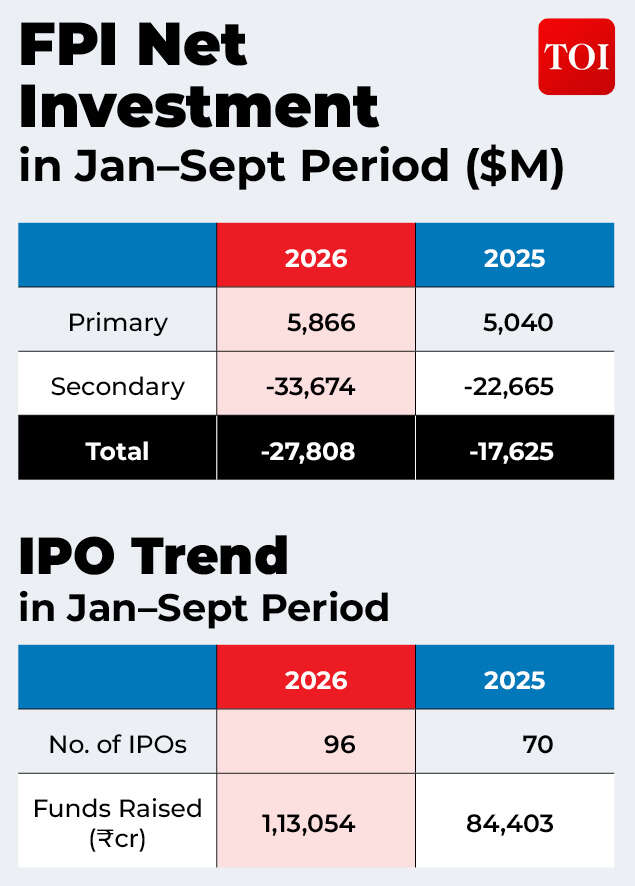
FPI Net Investment Trends between September 2026
Is investment in IPOs only about listing gains?
It’s a mix of both.Sneha Poddar of Motilal Oswal Financial Services says the institutional investment which anchors IPO issues is largely driven by genuine, long-term investment mandates.“Institutional funds use IPOs to acquire strategic, early-stage allocations in emerging sub-sectors (such as specialized electronics manufacturing, renewable energy supply chains, and digital infrastructure) that are underrepresented in traditional listed benchmarks,” she explains.On the other hand, non-institutional and retail participation remains heavily influenced by short-term momentum and listing-gain hunting.“The ongoing sell-off in Indian equities appears largely driven by FII risk aversion amid global macroeconomic uncertainties, which have diminished India’s relative attractiveness versus other emerging and developed markets.According to Vinod Nair, Head of Research, Geojit Investments Limited, the primary market has emerged as a compelling alternative, with several IPOs offering attractive business models and valuations, resulting in strong listing gains and investment opportunities across both short- and long-term horizons.“Improved IPO performance, reflected in average listing gains of nearly 18% in H1FY27 versus around 7% in FY26, has further strengthened retail participation. However, investor intent remains distinct across segments, with retail investors primarily chasing listing gains, while institutional and anchor investors continue to focus on underlying business fundamentals,” he tells TOI.Anchors and mutual funds largely invest for the long term, while a big part of retail and HNI demand is chasing listing gains.“Headline subscription numbers overstate real holding demand. That said, investors are becoming more selective. Well-priced, quality businesses are getting strong demand, and expensive issues are not,” says Ratiraj Tibrewal of Choice Capital Advisors.But what about the stock market, where is it headed in the long-term?
What is the stock market outlook?
Despite the ongoing bloodbath in Indian equities, market experts continue to maintain a constructive long-term outlook driven by strong domestic fundamentals.According to Sneha Poddar, while the near-term environment is likely to stay volatile, India’s domestic macroeconomic backdrop remains relatively resilient, with healthy GDP growth, strong credit growth, GST collections, auto and cement volumes, and robust domestic liquidity.More importantly, the earnings outlook is improving, with broad-based earnings growth expected to remain strong across financials, telecom, metals and oil & gas, she says.But global factors continue to have an overhang on the overall sentiment.“Near-term volatility will continue because of US yields, crude prices and foreign outflows. The domestic base is strong, though: earnings are recovering and SIP flows are steady,” says Ratiraj Tibrewal.“Domestic investors now own more of the market than foreign investors. Valuations aren’t cheap, so returns should track earnings growth. Quality large caps should hold up better than expensive small and mid caps,” he adds.Yet, it is also important to see the market movement as cycles.Thomas V Abraham notes that valuations are moving towards COVID lows. “Considering how the markets have performed in various cycles, this provides a good opportunity to park funds in long-term growth stocks. It is important to consider these funds as something that can be parked away for a decent time and not required in the near term,” he says.In fact, mid and small-cap indices have seen deeper corrections over the last quarter, while the Nifty 50 has demonstrated relative resilience.“Heading into the end of 2026, large-cap valuations are fairly priced. Without excess valuation froth, future upside is tethered directly to forward corporate earnings expansion rather than multiple expansion. Currently the Nifty50 is trading at valuations of about 17x its 12 month forward earnings which is way below its 10 year historical averages and provides a comfort zone for long term stock picking,” says Narendra Solanki, Head Fundamental Research – Investment Services, Anand Rathi Share and Stock Brokers Limited.Finally, market experts note that India’s economy remains resilient, with the RBI projecting 7.1% GDP growth in FY27, supported by investment and consumption, though inflationary pressures have prompted a repo rate hike to 5.5%.They believe that elevated energy prices, higher global bond yields, geopolitical uncertainty and persistent FII outflows could continue to weigh on market sentiment.“However, the correction over the past two years has resulted in a meaningful valuation reset, reducing some of the excesses seen in 2024. With earnings growth recovering and valuations becoming more reasonable, the risk-reward has improved, but the market is likely to remain firmly bottom-up,” says Sneha Poddar.(Disclaimer: Recommendations and views on the stock market, or any other asset classes or personal finance management tips given by experts and analysts are their own. These opinions do not represent the views of The Times of India.)